Minewind is a survival server built around choosing your own path and hunting down powerful loot that fits your play style. Find a wide variety of gear in chests across the world, trade with villagers for emeralds, and take on dangerous mon…
GT New Horizons
GT New Horizons servers are built around long-form GregTech progression that turns survival into an engineering timeline. You start with stone tools and steam, then move through voltage tiers where recipes, machines, and materials are deliberately gated. The pace is slow on purpose, but it stays focused. Advancement comes from proving you can produce, automate, and scale reliably before the next tier opens up.
Day to day, it plays like factory work with consequences. Early game is plates, dusts, circuits, and constant pressure on power and resources, where cable loss and weak generation make bad layouts hurt. Later, the challenge shifts to system design: ore processing that does not back up, chemical lines that stay fed, storage and routing that stay sane, and production chains that keep running without brownouts or clogged outputs. You spend a lot of time reading recipes and planning around bottlenecks, because the real decisions are about throughput and what to automate next.
In multiplayer, the best GT New Horizons servers feel like shared infrastructure projects. Players specialize, trade intermediates, and coordinate upgrades because solo hand-crafting does not scale. Bases grow into industrial districts with dedicated processing, power, and component lines, and progress is measured in tiers stabilized and systems that can run unattended, not in loot.
Expect an opinionated pack and a community that tends to respect its constraints. This format rewards patience, documentation, and teamwork more than combat skill. If you like turning a fragile starter setup into a stable, automated plant, GT New Horizons is one of the clearest expressions of that playstyle.
Is GT New Horizons good for groups, or does it get messy in co-op?
It works extremely well in groups when you agree on shared standards. The workload naturally splits into roles like power, ore processing, chemistry, and circuits. The common failure mode is uncoordinated builds: incompatible item routing, mixed voltage networks, or multiple people feeding the same line without buffers and overflow handling.
What does progression look like over time on a server?
Most servers advance by stabilizing a tier, then industrializing what that tier demands. You lock in a power source you can trust, build the core machines for that voltage, and automate the parts needed for the next set of circuits and machines. The real milestone is a chain that runs continuously without manual babysitting.
How do people keep it from feeling like endless crafting?
By treating hand-crafting as temporary. Healthy servers push early batch production, shared processing, and repeatable lines so players are not all making the same intermediates by hand. Once your common components are automated, the pack feels less like a grind and more like solving production constraints.
Do I need deep GregTech knowledge to join a server?
You do not need expertise, but you do need patience with systems and recipes. New players do best by building small, reliable lines, learning how the current tier is typically powered and routed, and asking before wiring into shared infrastructure. Most communities help if you respect the constraints and do not rush unsafe builds.
What makes a GT New Horizons server worth committing to?
Performance and consistency. Look for clear rules around claims, chunkloading, and machine setups that cause lag, plus signs of active progression like shared processing, a trade area, or a community hub. Because this format rewards long sessions, uptime and low lag matter more than extra features.
-
-
En Mineverso mantenemos el servidor actualizado y optimizado para que puedas jugar con una experiencia fluida y con buena conexión. Actualmente ofrecemos cinco modalidades para que elijas cómo quieres jugar: Survival, SkyBlock, SkyWars, Van…
-
3
 12/100OnlineTopBlocks is a competitive box server where everyone starts in a small box with limited resources, then works their way up through smart mining, selling, and upgrading. Progress is permanent with no resets, so your choices matter as you exp…
 -
ATOM-MC is a heavily modded Minecraft server hosted in South Africa, built for players who want progression and depth without losing the feel of survival. Jump into MCMMO, a dynamic economy, land claiming, and a mix of PvE with optional PvP…
-
Beakscraft is a new factions server built to bring back the classic feel of old-school multiplayer, without the toxicity, constant resets, or the pressure to raid everyone around you. Our focus is on factions as a long-term project: buildin…
-
6
 5/100OnlineCobblemon Vulkan is a Cobblemon survival server focused on competitive battling, with progression and activities built around your Pokédex. We run a curated modpack and include features like Dex ranks, Dex rewards, quests, and a unique curr…
 -
7
 3/50OnlineMetaUnion is a Minecraft network built around a friendly, helpful community and a mature, open-minded atmosphere. We keep things fair with an anti pay to win approach: donations only provide an in-game rank with no gameplay advantages. Our…
 -
8
 2/690OnlineWelcome to The Playhouse, a server built to give you variety without losing that close community feel. Jump into Medieval Survival, build without boundaries in our borderless Creative world with no plot limits, or take on Fallout Factions…
 -
9
 2/200000OnlineEchelonMC is a hand built, fully custom Survival SMP for players who want a long term world with real progression and an active community. We built everything from the ground up over two months of development, and we keep improving it every…
 -
10
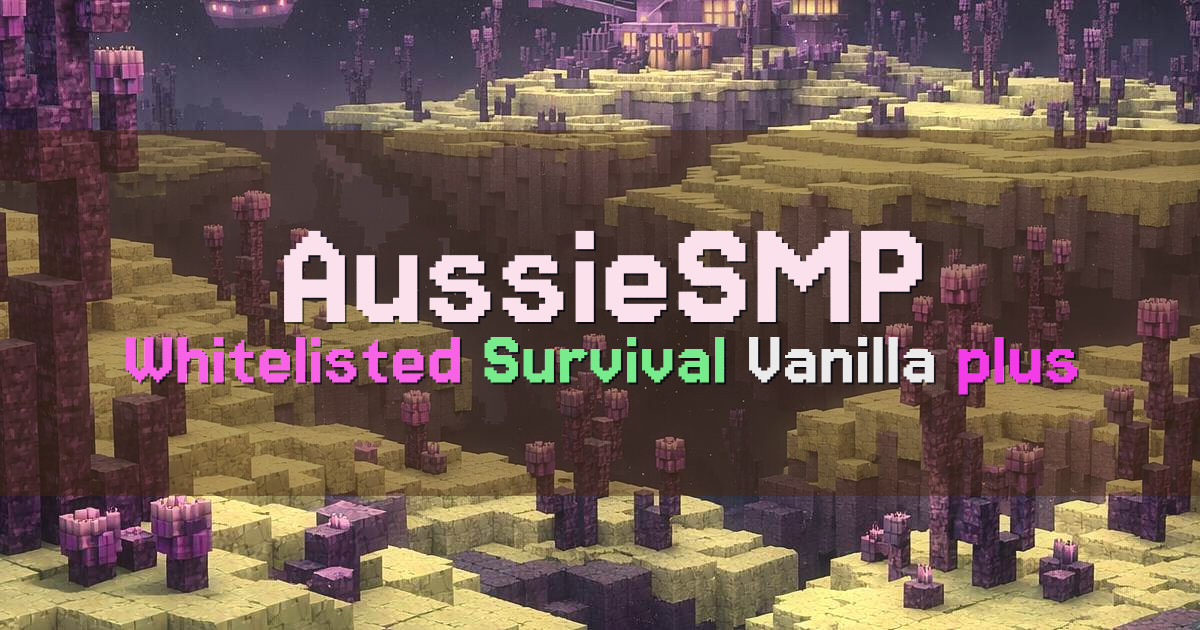 2/250OnlineAussieSMP is a Sydney-hosted Australian survival server built for a small, friendly community. We run a whitelisted, application-based setup to help keep the culture healthy and to make sure players can feel confident their builds will be r…