Minewind is a survival server built around choosing your own path and hunting down powerful loot that fits your play style. Find a wide variety of gear in chests across the world, trade with villagers for emeralds, and take on dangerous mon…
Mob Bosses
Mob Bosses servers are built around named, custom-tuned enemies that play more like repeatable encounters than upgraded zombies. The main loop is preparation and execution: get geared, stock potions and backups, learn the fight, then show up when a boss is available. Most other activities exist to feed that next attempt.
Boss design usually adds pressure and patterns vanilla mobs do not. Expect large health pools with phases, telegraphed area attacks, summons, knockbacks, debuffs, and arena hazards that force repositioning. Success comes from movement, timing, and awareness as much as damage, and sloppy play tends to cascade into wipes.
Progression is often boss-gated. Early kills unlock the next tier through unique drops, craft components, keys, or access to higher zones. The defining feel is that upgrades are earned by beating the encounter, not simply crafting a recipe, and boss loot stays valuable because it sets the pace for both gearing and trade.
The social game is constant. Some servers use instanced arenas and party scaling where the challenge is clean execution; others keep bosses in the open world where scouting spawns, forming alliances, and contesting tags matter. Either way, you fall into a rhythm of rallying a group, assigning roles, and deciding when to risk a contested fight versus farming safer progress.
Are bosses instanced or in the open world?
Both are common. Instanced bosses run in private arenas or party instances, keeping the focus on mechanics and scaling. Open-world bosses are shared spawns, so logistics, competition, and sometimes PvP pressure around the area become part of the encounter.
Can you play solo, or is a group required?
Early content is often solo-friendly, but later bosses are typically tuned for small groups or coordinated teams. Solo success usually depends on server scaling, defensive tools and consumables, and whether the server supports pets, summons, or other assistance.
What separates a real boss from a higher-health mob?
A boss has learnable mechanics and clear punishments: phases, telegraphs, adds, arena control, and fail states. The point is a fight you improve at over time, not a pure damage check.
How do drops and progression usually work?
Bosses commonly drop unique materials or tokens that feed the next gear tier, plus rarer items that stay relevant for trading. Many servers also use keys, completion requirements, or zone unlocks to structure the order of encounters.
Is PvP part of Mob Bosses gameplay?
Not always. Some servers are strictly PvE with leaderboards and fastest-clear culture. Others add PvP indirectly through contested spawns, territory control, or optional war zones where boss loot is the main risk-reward hook.
-
-
2
 99/200OnlineWelcome to FadeMC, a never-resetting Minecraft survival server for players who want a classic experience without the stress of losing everything. We keep things semi-vanilla and focused on what makes survival fun, while protecting your prog…
 -
Welcome to FlamingoMC, a unique BoxSMP survival experience where the challenge is real and progression matters. Start from the basics, mine resources, claim your land, and build your base as you work your way up through the ranks. We keep t…
-
4
 14/150OnlineWelcome to FaithAvenue, a Christian faith-focused, family-friendly city-themed network built to feel like a long-term home. Our world features a massive interactive city with shops, random events, and hundreds of places you can settle into…
 -
5
 13/50OnlineCasual Minecraft is a classic survival SMP for players who want Minecraft to feel simple, familiar, and community-driven again. We keep gameplay focused on true survival, with building, exploring, and collaborating happening naturally. No f…
 -
6
 7/120OnlineMinecraftOffline is a lifesteal anarchy server built around high-stakes PvP and survival. Kill players to gain hearts, and lose hearts when you die. If you run out of hearts, you’re banned. New players get a one hour grace period where hear…
 -
7
 6/50OnlineExandria MC is an Australian (Brisbane) survival server we started with a simple goal: make a world that feels alive. We’re building around ongoing lore, recurring NPCs, and custom questlines that are designed to feel like part of the world…
 -
8
 5/110OnlineNovaTek is an international, community-oriented SMP built for both technical players and casual players who want to enjoy the base game with minimal technical restrictions. Our main world is a no-resets, forever world meant for long-term bu…
 -
The Anchor is a Survival SMP built around a simple goal: a community that’s listened to, with server changes vetted through player feedback so progress-impacting reworks are handled carefully. We support crossplay for both Java and Bedrock…
-
10
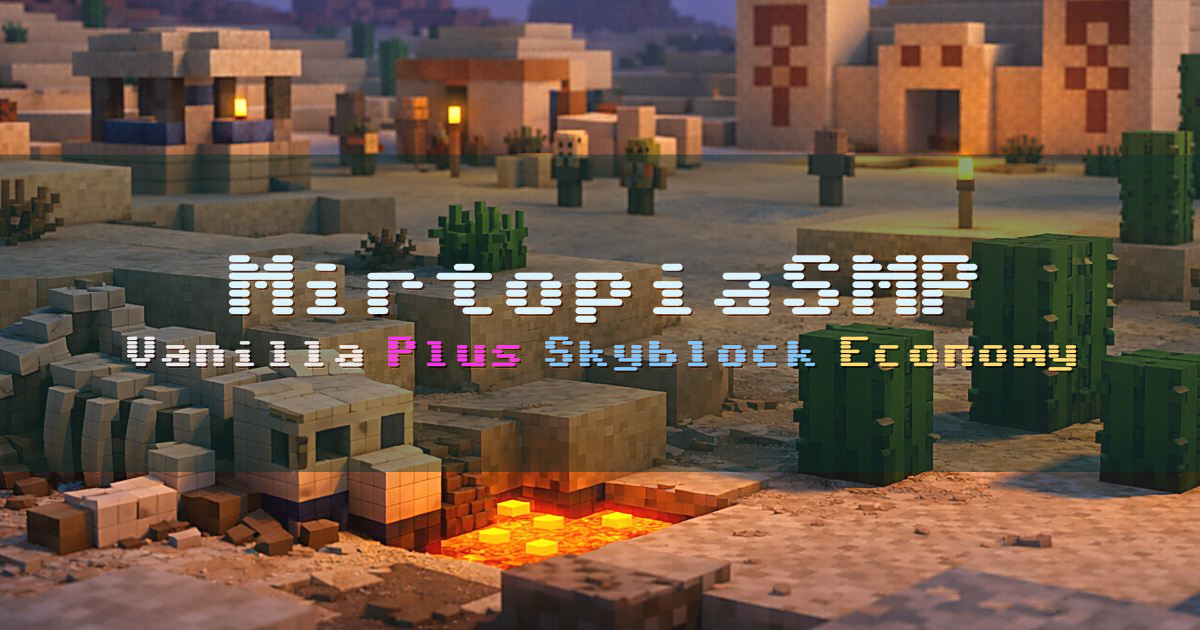 0/20OnlineMirtopiaSMP is a vanilla++ Minecraft server built for players who want true survival with a few quality-of-life features. We keep gameplay fair with no pay-to-win perks, while adding helpful commands like /home, /warp, and /tpa alongside la…