

Minewind is a survival server built around choosing your own path and hunting down powerful loot that fits your play style. Find a wide variety of gear in chests across the world, trade with villagers for emeralds, and take on dangerous mon…
Regional resources
Regional resources servers tie progression to geography. Instead of every base having access to the same materials a short strip-mine away, certain ores, crops, mob drops, or custom components are best sourced from specific regions. You feel it fast: your home area covers the basics, but the next upgrade nudges you to leave your comfort zone.
The gameplay loop becomes scout, secure access, move goods. Players build outposts near what they need, connect them with roads or Nether routes, and start treating transport like real infrastructure. A trip for one ingredient turns into a planned run with shulkers, waypoints, and a return path that stays safe.
This format creates an economy even on near-vanilla servers, because specialization has a purpose. Settlements form around reliable supplies, markets pop up between regions, and trade stops being roleplay and starts being time saved. If claims, factions, or PvP are in play, the politics follow: access deals, tolls, contested corridors, and occasional fights over the region that feeds a key part of the server’s meta.
The best setups use incentives more than hard locks. You can live anywhere, but you are rewarded for knowing the map and having connections. Done well, exploration stays relevant for months, bases feel meaningfully different, and progression is shaped as much by where you live as how efficiently you grind.
What usually gets regionalized on these servers?
Common approaches are biome-based ore weighting, region-only drops, climate-based crop bonuses, and recipes that need parts sourced from different zones or dimensions. Sometimes it extends to villagers, with trade pools that vary by town or region. The consistent idea is that location changes what is efficient to get.
Does it force constant travel?
You will travel more than on uniform-resource worlds, especially early. Later it usually settles into predictable runs and infrastructure: an outpost, a partner who supplies one material, or a route you can do quickly through the Nether. It shifts from wandering to logistics.
Is it viable to play solo?
Yes, but expect more expedition planning. Solo players often maintain a main base plus a few small resource posts, and they lean hard on shulker storage and Nether travel. Trading still tends to happen because it is faster than owning every region yourself.
How is this different from a typical economy server?
The economy is a consequence, not the premise. Some servers have no currency or shop plugins and still get strong trade because scarcity is geographic. Others add chest shops or auctions, but the defining feature is that the map itself creates supply and demand.
What rules make regional resources feel fair instead of grindy?
Clear guidance on where things come from, more than one viable source for progression-critical items, and travel tools that respect players’ time. The worst versions hide the system completely or bottleneck essentials into a single hotspot that turns progression into camping and gatekeeping.
-
-
2
 91/200OnlineWelcome to HeartSteal, a Survival server focused on LifeSteal gameplay with PvP and raiding. You can join from both Java and Bedrock, so friends on different editions can play together. We also run an economy and keep our community connecte…
 -
3
 34/100OnlineLoungeSMP is a cozy, semi-vanilla crossplay survival server for both Java and Bedrock players. We keep the classic survival feel intact with quality-of-life features, without overcomplicated systems, spammy extras, or any pay-to-win nonsens…
 -
4
 34/100OnlineEden is a vanilla-client survival server with tweaked progression designed to push players toward cooperation. Solo play is possible, but it’s intentionally brutal, and key crops and ores are region-locked. Where you choose to live matters…
 -
5
 11/100OnlinePrimordialMC is an MMO-style Survival server built around permanent progression. We don’t do resets or wipes, and we keep raiding off the table so the time you invest and the progress you earn stays yours. Progress through a 6-tier custom i…
 -
6
 10/80OnlineWelcome to The Mushroom Co. Survival, a friendly small survival server run by a close knit community of helpful players and staff. Our goal is simple: provide a great survival experience while supporting different play styles. We run Factio…
 -
7
 8/200OnlineViking Factions OG is built for players who want the classic factions experience with skill-based 1.8-style pot PvP, running on a modern Minecraft 1.21.4+ server. We focus on fair competition with no pay-to-win and a balanced economy. If yo…
 -
8
 7/300OnlineWelcome to Haider Network, a Minecraft server owned by YouTuber Haider Playz. We focus on PvP-driven gameplay with three main modes: Lifesteal, PvP, and our unique Gemsteal mode. You can join from both Java and Bedrock, with support for cra…
 -
9
 6/500OnlineCreative Central is a work-in-progress Minecraft network built on nearly 10 years of connected lore and worldbuilding. We focus on giving players room to create, settle, and tell stories in a shared world. We currently offer two main game m…
 -
10
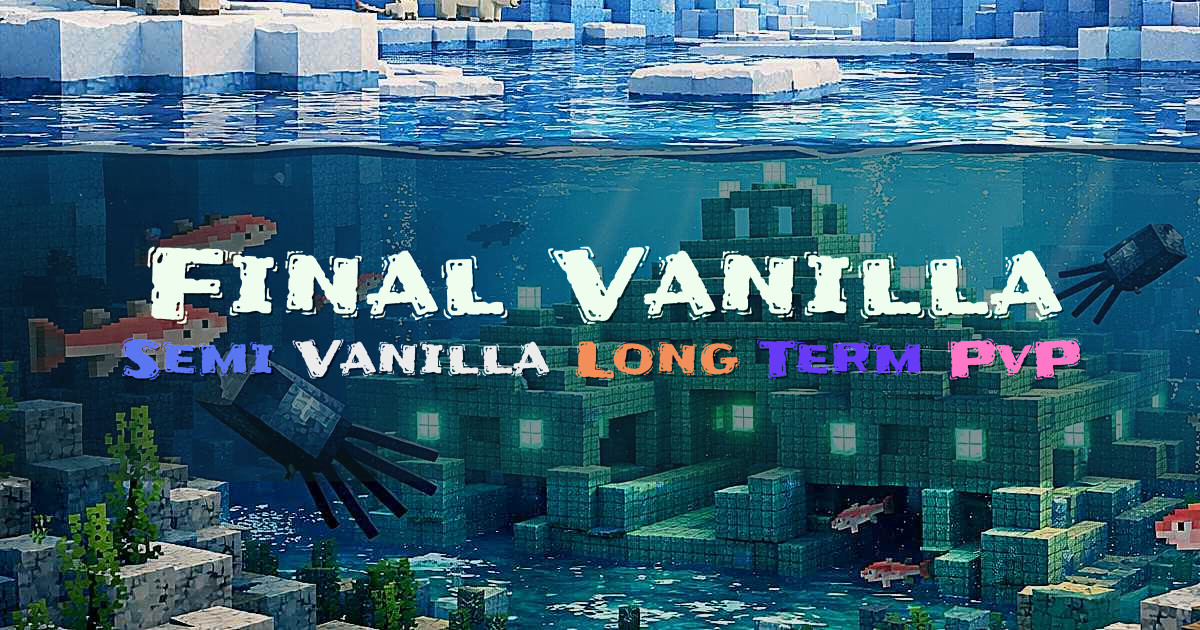 4/200OnlineFinal Vanilla is a brand new semi-vanilla server built for players who want a long-term world that stays fair and worth investing in. We keep gameplay mostly vanilla, with a few careful improvements aimed at protecting the experience and ke…