Minewind is a survival server built around choosing your own path and hunting down powerful loot that fits your play style. Find a wide variety of gear in chests across the world, trade with villagers for emeralds, and take on dangerous mon…
massive world
A massive world server treats the map as a long-term canvas: wide borders, lots of unclaimed terrain, and enough space for players to spread out without the server feeling empty. Instead of one crowded region, you get distant bases, slow-growing towns, and a frontier that stays worth exploring well past the first month.
The gameplay loop is built around distance. You travel farther to choose a biome, you invest in routes, and you start thinking in networks rather than neighborhoods. Nether highways, ice roads, portal hubs, and marked trails become real community infrastructure because getting home is part of the plan, not an afterthought.
Socially, big maps create a clear split between hubs and backcountry. Spawn districts, shopping areas, and public farms concentrate activity, while remote builds stay quiet and mostly uninterrupted. You still run into people, just more predictably: along main nether lines, at markets, and during shared projects.
With land pressure reduced, progression and economy lean toward convenience and logistics. The valuable things are access and time: well-linked portals, shops placed on transit corridors, delivery runs, and services that turn long distances into manageable trips. The best servers make the scale playable through coherent transport culture, clear expectations around claiming or protection, and performance choices that keep exploration smooth.
How big is a massive world in practice?
Commonly tens of thousands of blocks across, sometimes much larger. What matters is that new terrain stays available for a long time and players are not pushed into the same few thousand blocks.
Do massive world servers usually avoid resets?
Often. Large maps pair well with long seasons so roads, hubs, and megabases feel worth building. Some servers still reset resource areas or run a separate mining world while keeping the main overworld persistent.
Will it feel lonely compared to a smaller map?
It can if you base randomly with no ties. Most regular interaction clusters around spawn, shopping districts, event builds, and major nether routes. If you want neighbors, build near a hub or join a town; if you want privacy, you can go far out without losing access to shared infrastructure.
What keeps exploration meaningful once the world is huge?
The point is not endless wandering, it is finding a place and connecting it. Servers with an active transport network, community mapping, and shared projects turn discoveries into destinations rather than one-off screenshots.
Does a massive world make lag or travel time worse?
Travel time is part of the format, but good portal and road systems keep it reasonable. Performance depends more on server management than raw size, such as pregeneration, view distance, and how smoothly new chunks load.
-
-
2
 14/200OnlineRulerCraft is an Earth-based Towny server built around a full-scale world map with all continents, varied biomes, and ores. Start your own town and grow it into a nation, or join an existing group and help expand its territory and influence…
 -
MCVerse is a long-term, no-reset Survival SMP for players who want a permanent place for big projects and a world that keeps going even if you take long breaks. There’s no race here: build solo, collaborate, or just settle in and play…
-
4
 8/50OnlineWelcome to Aggroculture SMP, a semi vanilla survival server built for players who want real risk, real progression, and an economy that comes from the land. We focus on farming and PvP with a multi-crop, player-driven economy and skill-base…
 -
5
 7/200OnlineSunflower SMP is a friendly, safe, and relaxing place to play Survival with a community-first focus. We keep things welcoming and low-stress with keep-inventory and a selection of cute cosmetics. Settle in and build with land claiming, take…
 -
6
 5/500OnlineWelcome to PGMC World, a PvE-focused Survival and Towny server built around long-term progression and a fair experience. We run with no pay to win and no PvP, so you can focus on building, exploring, and leveling up. Settle into town life…
 -
7
 2/2026OnlineVintage Survival is a survival server built around a classic, community-driven Minecraft experience. Our goal is to keep things simple and balanced, with smooth survival gameplay that stays true to the vanilla feel. We focus on fairness and…
 -
8
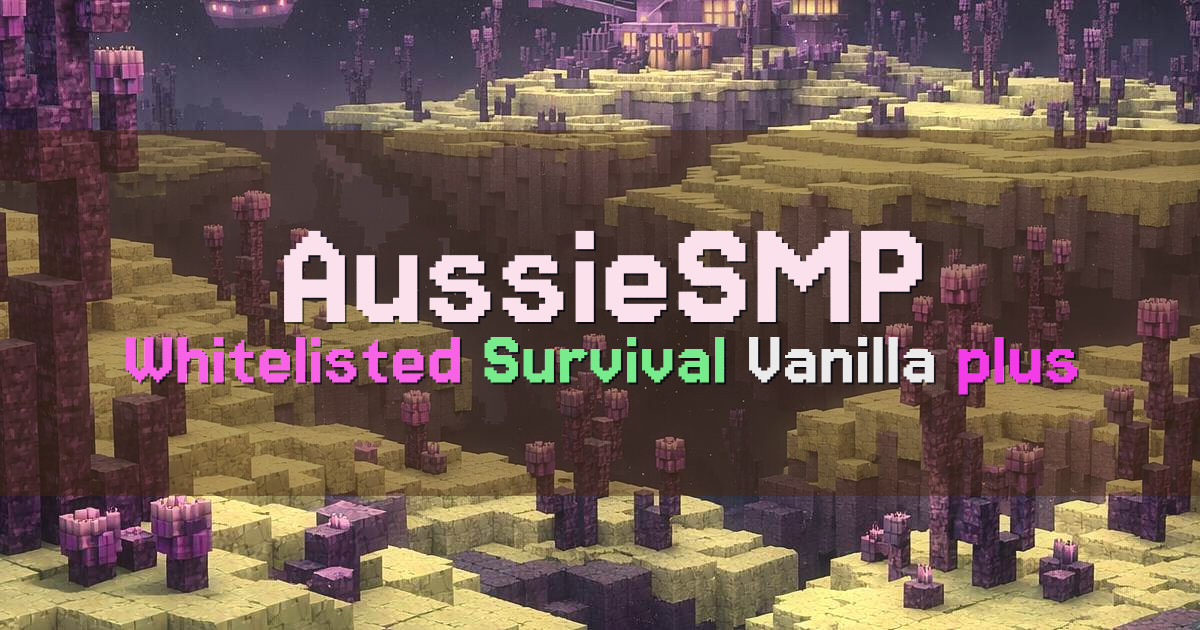 2/250OnlineAussieSMP is a Sydney-hosted Australian survival server built for a small, friendly community. We run a whitelisted, application-based setup to help keep the culture healthy and to make sure players can feel confident their builds will be r…
 -
We run a brand new vanilla-style Survival server on Fabric, focused on keeping Minecraft mechanics feeling right. Redstone and farms behave the way experienced players expect, so you can build reliable systems without fighting unusual chang…
-
Welcome to SunRealms, a Minecraft server featuring Skyblock, Generators, Survival, and Prison. We focus on a friendly community with dedicated staff and regular events to keep things fresh, whether you are building up your island, progressi…